Summary
Index
Introduction
It’s a sunny Wednesday afternoon, and I’m listening to Blue by Joni Mitchell. It’s a grey Tuesday morning, and I’m listening to Blue. When I can’t sleep or am struggling to wake up, I’ll listen to Blue again. To say this woman has narrated many chapters of my life would be an understatement.
There’s something about Mitchell’s voice that seems to meet me wherever I am. Her songs feel less like performances and more like quiet conversations - intimate observations of love, loneliness, freedom, and the strange contradictions that come with being human.
But one thing that makes me fall even more in love with the dulcet tones of this musical genius and lyricist is her affinity for cats, something that quietly appears throughout her life and creative world. From childhood memories to paintings and songs, cats drift through Mitchell’s story the way they drift through any house, appearing quietly, watching everything, and leaving again when they feel like it.
Exploring Joni Mitchell’s lifelong relationship with cats reveals something deeper than simple pet ownership. It reveals an instinct for observation; a way of looking at the world that shaped both her songwriting and her artistic identity.
A childhood of watching
Mitchell’s love of cats began long before she became the voice behind Blue or Court and Spark.
Growing up in Saskatchewan, Canada, cats were simply part of rural life. But they weren’t treated as domestic companions in the way many people think of them today. They were barn cats - mousers that lived on the edges of farms and neighbourhoods, keeping rodent populations down and wandering between properties.
Mitchell once reflected on this upbringing in an interview, saying:
“My mother was also a farm girl, and cats were not indoor things. They were for the barn. But I knew every cat in my neighbourhood.”
Though it might seem like a small memory, it’s a revealing one. Long before Mitchell became known for her songwriting, she was already an observer, noticing personalities, movements, and the quiet lives unfolding around her. The neighbourhood cats were among her earliest subjects. That instinct to observe would eventually become one of her greatest artistic strengths.



The observer behind the music
Listening to Mitchell’s music often feels like reading someone’s diary written in melody, raw, reflective, and deeply human - sometimes, uncomfortably so.
Her songs rarely rely on grand gestures. Instead, they pay attention to the subtleties of life: the pauses in conversation, the small heartbreaks, the moments of clarity that appear unexpectedly.
“He went to California, hearing that everything’s warmer there. So you write him a letter and say “her eyes are blue”, he sends you a poem, and she’s lost to you.”
It’s a style that made albums like Blue so enduring. Released in 1971, the record remains, in my opinion, one of the most intimate and emotionally honest albums ever made. But the skill behind those songs is observation.
“It’s coming on Christmas, they’re cutting down trees. They’re putting up reindeer and singing songs of joy and peace. Oh, I wish I had a river I could skate away on.”
Mitchell has often spoken about how closely she watches the world around her: people, landscapes, relationships, and the emotional shifts that occur between them. It’s the same instinct that once led her to notice every wandering cat in her childhood neighbourhood.
Before she was studying heartbreak and freedom in songs like those on Blue, she was studying personalities in another form entirely. Cats just happened to be among the first.
Cats in the creative space
Music is only one part of Mitchell’s creative life. Throughout her career, she has described herself as a painter first, moving fluidly between visual art and songwriting.
Several of her album covers feature her own artwork, including Ladies of the Canyon. Painting has always been a parallel form of expression for Mitchell, another way to observe and interpret the world around her.
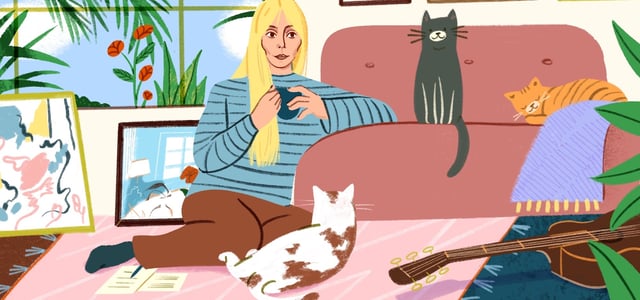
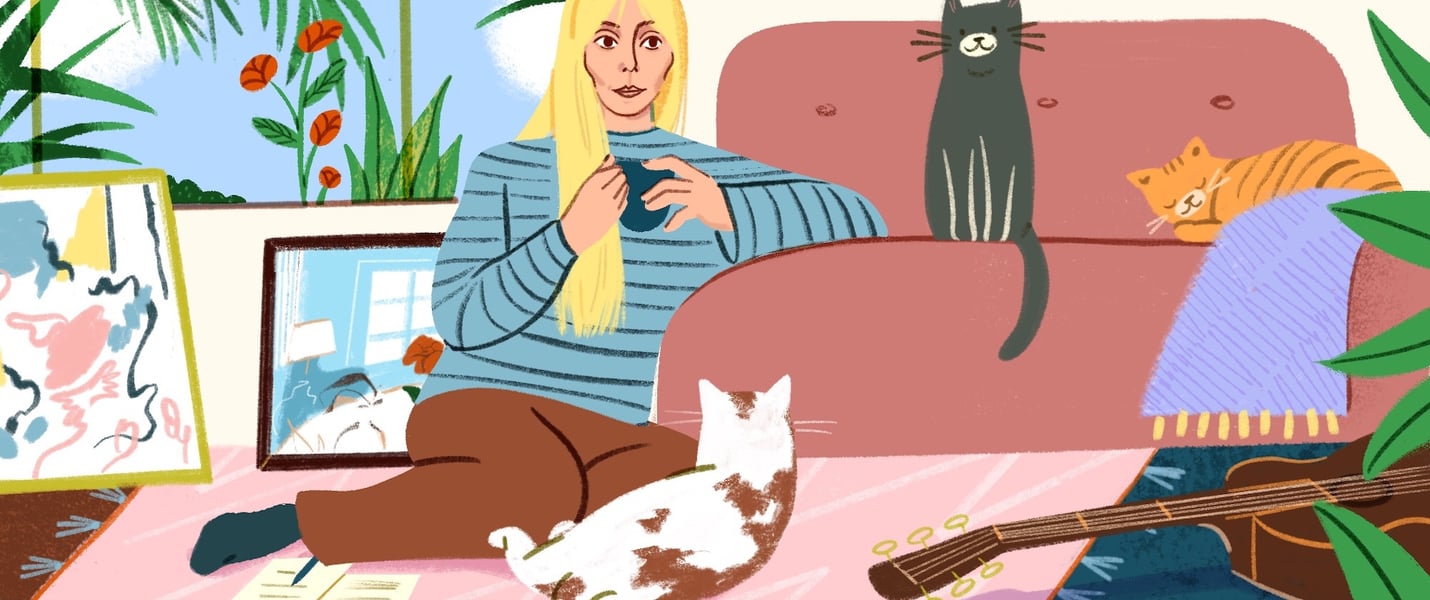
In her paintings and studio sketches, domestic scenes often appear: rooms filled with light, half-finished canvases, and quiet moments of reflection. Cats occasionally drift through these spaces too, appearing almost like silent studio companions.
It’s easy to imagine them there, perched on windowsills, wandering between paintbrushes and guitars, observing the creative process without interrupting it. After all, aren’t cats the masters of quiet presence?


A cat-like spirit with guitar in hand
In many ways, it would be fair to say that Mitchell herself shares some of the same qualities we associate with cats.
Her career has been defined by independence. At the height of the folk movement in the late 1960s, she began incorporating jazz and experimental influences into her music. When audiences expected more of the same sound that had made her famous, she shifted direction entirely. In an interview for Rolling Stone magazine in 1979, she famously declared, “They'll crucify you for staying the same, and they'll crucify you for change. I'd rather be crucified for changing.”
Albums like Court and Spark and The Hissing of Summer Lawns show an artist constantly evolving, following curiosity rather than expectations. Like a cat wandering from room to room, Mitchell has always moved through creative spaces on her own terms. Curious, observant, impossible to domesticate.
Hunter: a cat worth writing about
Mitchell’s affection for cats was more than philosophical; it also appeared in her personal life. At one point, she wrote about a stray cat named Hunter, a wandering feline who eventually became part of her home. The story reflects the kind of quiet bond that often forms between humans and cats: one built slowly, through patience and shared space rather than deliberate adoption. Cats, after all, tend to choose their people rather than the other way around.
Hunter’s presence in Mitchell’s life speaks to the same theme that runs through much of her work: an appreciation for independence, for creatures who exist freely and form connections on their own terms. For many artists, animals offer a kind of companionship that humans rarely can. They don’t demand explanations or emotional clarity - they just share space, and cats are particularly good at this. They sit beside you while you work, watching the room with patient curiosity. They exist quietly in the background, offering presence rather than attention.
For someone as introspective as Mitchell, it’s easy to imagine why that kind of companionship might matter. Creative work often requires solitude, reflection, and long stretches of quiet observation, the exact environment where cats thrive.
Conclusion
It’s a sunny Wednesday afternoon, and Blue is playing again.
Outside my window, neighbourhood cats move between gardens with the same quiet confidence they’ve always had - independent, curious, completely themselves. A particular cat takes a shine to sitting on my fence as if he owns it. I don’t mind, he’s just passing through, and he makes me smile.
Listening to Joni Mitchell, it’s easy to see why she noticed them. And perhaps that’s why cats feel so at home in her world. Mitchell’s music, much like a cat, doesn’t demand attention. It simply waits, patient and self-assured, until you notice it.
And once you do, it’s hard to imagine life without it. If we take a moment to pause, to reflect, to just stop - what else could we notice?
After all, anyone who pays that much attention to the world, to its small moments, its overlooked characters, and its strange and beautiful contradictions was always going to notice the cats too.

From everyday questions to expert advice, we’ll help you feel confident in every moment of pet parenthood.
Less stress, more love.
Along with our excellent coverage, we offer access to a 24/7 online vet to answer all your sticky questions.